阅读笔记
FlashMemory-DeepSeek-V4: Lightning Index Ultra-Long Context via Lookahead Sparse Attention
FlashMemory-DeepSeek-V4 在 DeepSeek-V4-Flash 的 HCA / CSA 结构上增加一个 lookahead Neural Memory Indexer,把历史 CSA chunk 放入 CPU cold pool,再按未来约 64 个 token 的预测需求取回少量 chunk;它把平均物理 KV 占用降到 full-context baseline 的 13.5%,平均分数从 76.9 提到 77.5,但证据主要来自技术报告、内部 SGLang 日志和未完整释放的生产 KV swap 路径。
Source
- arXiv: 2606.09079
- arXiv HTML: FlashMemory-DeepSeek-V4
- Code: libertywing/FlashMemory-Deepseek-V4
- Code snapshot inspected:
main@39fe54d, 2026-07-13 - Model: libertywing/FlashMemory-Deepseek-V4
- Version: v2, submitted 2026-06-08, revised 2026-06-09
- Comments: Technical report, 11 pages
- Subjects: Machine Learning and Artificial Intelligence
作者与关系
- Yan Wang:Independent Researchers;Tencent。
- Qifan Zhang:Tencent;The Hong Kong University of Science and Technology (Guangzhou)。
- Jiachen Yu:Tencent;Tsinghua University。
- Tian Liang:Tencent;Tsinghua University Shenzhen International Graduate School;Wuhan University。
- Dongyang Ma:Independent Researchers。
- Xiang Hu:Tencent。
- Zibo Lin:Tencent。
- Chunyang Li:Tencent。
- Zhichao Wang:Tencent。
- Miao Peng:Tencent;The Hong Kong University of Science and Technology (Guangzhou);Wuhan University;Northeastern University。
- Nuo Chen:Tencent;The Hong Kong University of Science and Technology (Guangzhou);Peking University;Beijing University of Posts and Telecommunications。
- Jia Li:The Hong Kong University of Science and Technology (Guangzhou);The Chinese University of Hong Kong;Google AI;Tencent AI Lab。
- Yujiu Yang:Tsinghua University;Chinese Academy of Sciences Institute of Automation / National Laboratory of Pattern Recognition。
- Haitao Mi:Tencent。
- Dong Yu:Tencent。
阅读目标与判断边界
- 关注点:它如何训练 indexer、如何把未来窗口标签构造成 chunk-level 监督、如何和 DeepSeek-V4 的 CSA/HCA 既有 top-k selector 组合。
- 评估重点:KV memory 降幅、准确率保持、MRCR / no-context / 超训练长度失败边界,以及 release 后能否复现生产结论。
- 判断边界:本文是 arXiv technical report,未找到公开 peer review;代码仓库主要释放 Neural Memory Indexer 和 toy loop,生产 SGLang 集成、CPU-GPU swap scheduler、MRCR fallback 没有完整公开。
论文脉络
1. 背景:DeepSeek-V4 已经压缩 KV,但 CSA 仍然消耗历史 residency
DeepSeek-V4 通过 interleaved HCA / CSA 支撑 million-token context:
- HCA 以约
的粒度保留全局压缩上下文,承担低频全局信号。 - CSA 继承 DeepSeek-V3.2 / DSA 的 lightning indexer,在每步从压缩 KV entry 中选 top-k,以恢复局部和稀疏精确信息。
- 真实 serving 中,长上下文的瓶颈会从 attention FLOPs 转向物理 KV cache residency:即使每步只访问少数 chunk,系统仍可能把大量历史 CSA KV 留在 GPU 上,等待未来可能访问。
FlashMemory 的切入点是把“哪个 chunk 未来会被用到”独立建模,让 GPU 上只保留预测会被 CSA selector 使用的候选集合。
2. 核心设定:lookahead sparse attention
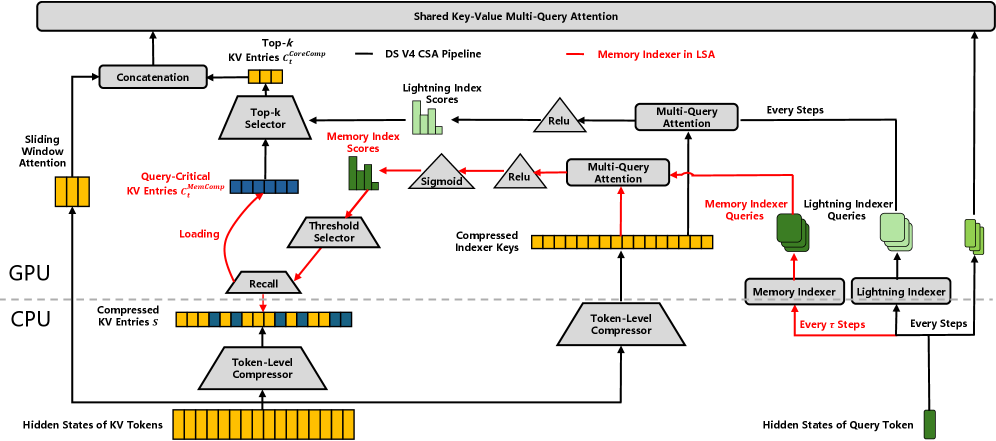
论文把 Lookahead Sparse Attention (LSA) 定义为两阶段选择:
- Memory Indexer 从当前 hidden state 预测未来窗口
需要哪些历史 chunk。 - DeepSeek-V4 原生 lightning indexer / top-k selector 在这些被取回的 chunk 内继续做细粒度选择。
因此 LSA 是一个 residency predictor。它不替换原始 CSA selector,而是缩小 selector 可访问的 GPU resident candidate set。
推理路径可以概括为:
- HCA 保留全局压缩表示。
- 最近窗口和正在 decode 的 token 保留在 GPU。
- 历史 CSA chunk 默认在 CPU cold pool。
- 每隔
个 decode step,Memory Indexer 对历史 chunk 打分。 - 分数超过阈值的 chunk 被取回 GPU。
- 每个 token 的 CSA 仍使用 DeepSeek-V4 原生 top-k 逻辑。

3. Memory Indexer 打分函数
论文把 indexer 做成 dual-encoder 风格:query side 可训练,key side 使用冻结的 compressed key 表示。对第
同时生成 head-wise 权重:
对历史 chunk
阈值选择:
随后每个 token 的原生 selector 在取回集合内继续做 top-k:
生产配置使用第
这里的
当前公开仓库 main@39fe54d 用这组结果生成一份全局布尔 resident_set。只要任一路选中 chunk
因此,一个 target layer 的正预测可能触发同一历史位置在多个 CSA 层上的 layer-specific KV page recall。OR routing 优先降低漏取关键 chunk 的风险,同时会放大 false positive 带来的 CPU-GPU 传输和 HBM 占用。三层选择是质量与取回比例的经验 Pareto 折中;论文提到
4. 标签构造:从未来真实 attention/top-k 反推 chunk 监督
训练的关键是把未来窗口中哪些 chunk 被 DeepSeek-V4 原生 selector 访问过,变成当前时刻
对未来 token
论文使用
再跨 CSA 层投票:
最后把未来
这个标签管线把正样本规模从约
5. 训练目标:冻结 key encoder,只训练 query-side projection
训练数据来自约
基础二分类损失:
最终使用 focal loss 处理正负样本不平衡:
论文采用
6. 实现边界:公开仓库包含两级 recall,复现仍耦合 DS-V4 / SGLang
截至 2026-07-13,GitHub main@39fe54d 已包含 retriever、modified SGLang 和 high-concurrency launch path:
- retriever 输入 layer-specific hidden state 与 compressed key,输出逐 chunk sigmoid score;
compressed_k使用bytes float8_e4m3key values 加bytes float32 scale,共 bytes per chunk。 - Mode A 将非 resident chunk 的 score 置为
,完整 KV 仍在 GPU,适合复验选择逻辑,不能验证真实 offload memory saving。 - Mode B 使用 prefill / decode disaggregation,在 decode 侧把 c4 KV 与部分 index-K 放入 CPU mirror;每
step 更新全局 resident_set,通过 page recall、GPU reserve 和 asynchronous recall 恢复选中位置。 - Level 2 在所有
个 c4 层上运行原生 top- ,并用 resident_set屏蔽未取回 chunk。README 还记录了 MRCR threshold fallback 和 256K 到 1M 的参考吞吐。
因此,公开代码已经覆盖从三层 ensemble 到 page-level offload / recall 的主要路径。论文表格与 README 性能数字仍来自作者环境,复现需要匹配 DeepSeek-V4、modified SGLang、PD 拓扑、checkpoint、阈值和 GPU/CPU memory 配置;当前证据还不足以确定其他 serving stack 上的吞吐、tail latency 与互连压力。
关键实验/定理
结果 1:平均物理 KV 降到
论文主表用 DS-V4-Flash full-context baseline、FM-DS-V4、Recency Only 和 Random 10% 对比。所有方案都保留 HCA、最近
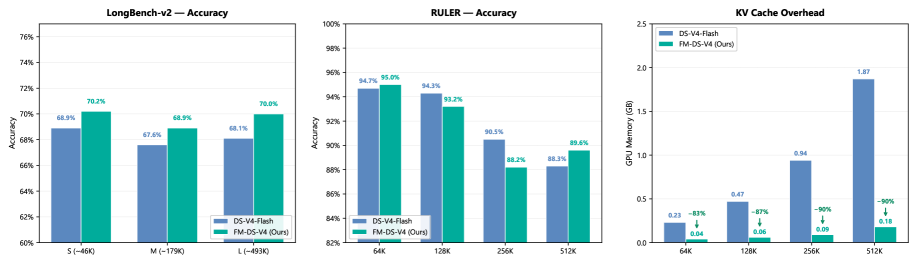

| Benchmark | DS-V4-Flash | FM-DS-V4 | Recency Only | Random 10% |
|---|---|---|---|---|
| LongBench-v2-S 46K | 68.9 / 0.17 GB | 70.2 / 0.04 GB | 50.0 / 0.03 GB | 53.3 / 0.04 GB |
| LongBench-v2-M 179K | 67.6 / 0.65 GB | 68.9 / 0.08 GB | 54.4 / 0.03 GB | 48.9 / 0.09 GB |
| LongBench-v2-L 493K | 68.1 / 1.80 GB | 70.0 / 0.18 GB | 54.3 / 0.04 GB | 46.9 / 0.22 GB |
| LongMemEval-S 125K | 80.6 / 0.46 GB | 82.0 / 0.06 GB | 19.2 / 0.04 GB | 20.1 / 0.07 GB |
| LongMemEval-M 500K | 39.3 / 1.82 GB | 40.2 / 0.17 GB | 23.1 / 0.04 GB | 25.7 / 0.22 GB |
| RULER 64K | 94.7 / 0.23 GB | 95.0 / 0.04 GB | 36.6 / 0.03 GB | 52.8 / 0.05 GB |
| RULER 128K | 94.3 / 0.47 GB | 93.2 / 0.06 GB | 21.6 / 0.03 GB | 32.3 / 0.08 GB |
| RULER 256K | 90.5 / 0.94 GB | 88.2 / 0.09 GB | 20.6 / 0.04 GB | 41.2 / 0.12 GB |
| RULER 512K | 88.3 / 1.87 GB | 89.6 / 0.18 GB | 18.8 / 0.04 GB | 27.2 / 0.22 GB |
| Avg | 76.9 / 0.93 GB | 77.5 / 0.10 GB | 33.3 / 0.04 GB | 38.7 / 0.12 GB |
解读:
- 平均分数
对 ,说明 Memory Indexer 在这些任务上没有明显破坏原生 CSA 的选择质量。 - 平均 physical KV footprint 从
GB 到 GB,约为 baseline 的 。 - 500K 左右任务上保持约
KV reduction。 - RULER 128K / 256K 中 FM-DS-V4 低于 DS-V4-Flash,显示 sparse residency predictor 在某些精确定位任务上会丢 chunk。
结果 2:No-Context 诊断暴露 O(1) memory 目标尚未达成
| Benchmark | DS-V4-Flash | FM-DS-V4 |
|---|---|---|
| LongMemEval-S no context | 96.7 / 0.46 GB | 95.0 / 0.06 GB |
| LongMemEval-M no context | 91.2 / 1.82 GB | 92.5 / 0.16 GB |
作者用 no-context setting 检查 false positive chunk retention。理想情况下,当答案不依赖长上下文时,历史 CSA chunk 应接近常数级保留。结果显示长度从 125K 到 500K 时,占 baseline 的比例从约
这说明固定阈值 sigmoid classifier 会积累 false positives,LSA 在当前形态下更接近“强压缩线性增长”,还没有达到 O(1) historical CSA residency。
结果 3:MRCR 是主要失败案例
论文报告 Multi-Round Coreference Recall (MRCR) 从 DS-V4-Flash 的
- LongBench、LongMemEval、RULER 中,只保留
或 golden CSA chunk 仍能保持 baseline 质量。 - MRCR 即使保留
true golden chunk,准确率仍下降约 。
论文给出三个原因:
- 冻结 key 表示缺少任务特定 adaptation。
- 浅层 dual-encoder cross interaction 不足以处理复杂多跳指代。
- decoupled training 隔离于 generation dynamics,indexer 的局部二分类目标没有直接优化多轮消解质量。
这也是 release model card 提醒“精确 needle-retrieval 需要额外 fallback”的背景。
结果 4:长度泛化安全范围约到训练长度的
作者发现 indexer 可以安全泛化到训练上下文长度的约
结果 5:简单 baseline 被明显击败,强系统 baseline 仍不足
Recency Only 与 Random 10% 在多数任务上大幅低于 FM-DS-V4,说明长上下文访存不能用纯近因或随机采样解释。更严格的对比仍然缺失:
- 没有和通用 sparse-attention serving framework 做 end-to-end throughput 对比。
- 没有和 RetrievalAttention、RazorAttention、StreamingLLM、H2O 等历史 KV sparsification baseline 做系统化同环境比较。
- 论文正文没有报告 decode latency、prefetch overlap、PCIe / NVLink bandwidth pressure、tail latency 和 batch-level scheduling;当前仓库 README 补充了 256K 到 1M 的参考吞吐,仍缺少误差范围、tail latency 与链路流量。
证据链强度评估
- 强证据:主表覆盖 LongBench-v2、LongMemEval、RULER,并使用 DS-V4-Flash 原生 baseline;代码和 Hugging Face 释放了 retriever 权重,当前仓库还提供 modified SGLang 的两级 recall 与 offload path。
- 中等证据:训练标签、focal loss、层 ensemble、阈值选择有清晰描述,且作者报告约
次内部训练探索;细节足以理解 recipe,但缺少 ablation table。 - 弱证据:production memory / throughput 仍来自作者 SGLang 日志与 README;代码虽已公开,尚无独立复现,延迟分布、互连流量和强 serving baseline 仍不足。
- 风险证据:MRCR 失败、no-context false positives、长度外推边界都说明 LSA 当前还需要 fallback / recalibration / dynamic threshold 才能用于强精确召回 workload。
OpenReview / 审稿意见吸收
- 未找到公开 OpenReview 或会议审稿页面;当前按 arXiv technical report 处理。
- 没有 reviewer rebuttal、acceptance decision、官方 revision log 可吸收。
- 后续若出现会议版本,应重点检查:MRCR fallback 是否公开、层选择与阈值是否有 ablation、end-to-end latency 是否补齐、1M+ context 是否重新训练并验证。
本地讨论补充
- 对“通过时间预测相关 token 并预取 KV cache”的更精确表述:在时刻
,Memory Indexer 根据当前 hidden state 预测接下来 个解码步可能访问的历史 KV chunk,并提前将这些 chunk 从 CPU cold pool 调回 GPU。预测目标是未来窗口的 chunk-level 访存集合,未来输出 token 的身份不在预测目标中;每个解码步实际访问哪些历史 entry,仍由原生 CSA selector 在 resident set 内执行 top- 决定。 - 本文是 DeepSeek-V4 的外部附加 memory-indexing 节点,重点在 GPU KV residency 管理。
- 与 MiniMax Sparse Attention 的关系:MiniMax MSA 把 trainable sparse selector 放进模型架构和训练流程;FlashMemory 在 frozen DeepSeek-V4-Flash 上离线训练一个 lookahead retriever,用于服务阶段决定历史 CSA chunk 是否回到 GPU。
- 与 GLM-5.2 的关系:把当前解码步
、第 层的选择集合写成 。GLM-5.2 的 IndexShare 沿层深轴复用 anchor layer 的 top- indices,FlashMemory 沿解码时间轴预测未来窗口需要驻留的历史 KV chunk;前者减少 indexer FLOPs,后者管理物理 KV residency 与 CPU--GPU 预取。 - 三路 indexer 的并集发生在历史 chunk position 层面。若第
层单独选中 chunk ,全局 resident_set[42]也会置为 true,runtime 随后恢复该位置所需的 layer-specific KV pages。各层不会共享同一份 KV 数值,恢复也不代表所有层都会 attention 到该 chunk;每个 CSA 层仍在 resident set 内独立执行 native top-。
主要启发
- 长上下文推理可以拆成两个独立决策:本 token 看哪些 entry,以及未来一小段时间哪些 entry 值得留在快存储中。前者是 attention selection,后者是 KV residency prediction。
- Lookahead label 比即时 top-k label 更适合 serving,因为 swap / prefetch 需要提前量;
把模型预测目标对齐到系统调度周期。 - 冻结 key、训练 query projection 是实用工程折中:训练便宜、部署轻量、对 base model 干扰小,但复杂检索任务会暴露 cross interaction 不足。
- 固定阈值二分类会导致长上下文 false positive 累积。后续更值得尝试 dynamic budget、top-k-by-memory、calibrated threshold、length-aware threshold 或 per-layer quota。
- 对 agentic serving,Memory Indexer 可以作为 KV prefetch / eviction policy 的学习组件;但多轮 tool-use 会改变未来访问分布,训练标签需要覆盖 tool result、conversation turn 和 retrieval-heavy prompt。
局限
- 技术报告没有 peer review 证据,也没有种子、误差条或统计显著性。
- 当前仓库已公开 modified SGLang 的 KV offload / recall path,但实现与 DeepSeek-V4 c4/CSA、PD 拓扑和特定 checkpoint 紧耦合,尚缺独立复现。
- MRCR 与精确多跳指代是明显短板,需要 fallback。
- no-context 结果说明 false positive 随 context 增长累积,O(1) historical CSA residency 尚未成立。
- 训练到
后最多安全外推到约 , 以上需要重新验证。 - 没有系统比较不同 sparse attention serving / KV eviction 方法的 end-to-end latency、吞吐和 tail behavior。
跨论文关系
- 与 DeepSeek-V4:FlashMemory 复用 DeepSeek-V4-Flash 的 HCA / CSA 结构,新增独立 Memory Indexer 预测未来窗口需要的 CSA chunk,是 V4 heterogeneous KV cache 方向的外部补充。
- 与 DeepSeek-V3.2 / DSA:DSA 处理 token-level MLA latent KV entry top-k;FlashMemory 处理 chunk-level GPU residency,二者上下游组合。
- 与 IndexCache:IndexCache 沿网络深度复用 top-
token positions,Shared 层仍读取各自的 KV,主要减少 indexer FLOPs;FlashMemory 沿生成时间预测未来窗口需要驻留的 KV chunks,主要减少 HBM residency 与无效搬运。两者优化轴互补。 - 与 Conditional Memory / Engram:Engram 把条件 lookup 做成模型能力和参数容量扩展;FlashMemory 把条件 lookup 用于 serving-time KV cache 管理。
- 与 MiniMax Sparse Attention:两者都训练 selector/indexer;MSA 是架构内 block sparse attention,FlashMemory 是冻结模型上的 lookahead dual-encoder retriever。
- 与 GLM-5.2:两者都围绕 DSA/long-context indexer 成本做工程化优化;GLM-5.2 强调 indexer/KV 共享复用,FlashMemory 强调 CPU cold pool 和未来窗口取回。
- 与 Span Query / Parrot:这些工作从 application structure 暴露 locality,FlashMemory 从模型 hidden state 预测 future locality,二者可在 agentic serving 中形成上下层信号。
Reference Intake Brief
- Primary artifact: arXiv v2 technical report, TeX source, GitHub retriever code, Hugging Face model card。
- Core concepts to index: FlashMemory, Lookahead Sparse Attention, Neural Memory Indexer, future-window chunk label, frozen compressed key, query-side low-rank projection, focal loss, CSA chunk CPU cold pool, DeepSeek-V4-Flash, HCA/CSA, SGLang integration。
- Quantitative anchors: average accuracy
vs ; average physical KV GB vs GB; average footprint ; KV reduction near 500K; MRCR vs ; no-context FM-DS-V4 GB at 125K and GB at 500K。 - Reusable equations: indexer sigmoid score, future-window golden label, focal loss, three-layer union routing。
- Follow-up checks: public review status, production SGLang integration release, MRCR fallback, 1M+ retraining, latency / throughput / tail latency measurements。