阅读笔记
DeepSeek V3.2: Pushing the Frontier of Open Large Language Models
DeepSeek-V3.2 把三条扩展路径合入同一模型:DSA 用 per-layer lightning indexer 将 128K MLA 的 core attention 限制到每个 query 最多 2048 个 latent KV positions;scalable GRPO 用 unbiased KL、off-policy negative-sequence masking、keep routing 和 keep sampling mask 控制长时间 RL 的分布偏移;agent pipeline 再用真实 code / search / interpreter 环境与 1,827 个合成环境训练 thinking tool-use。公开结果支持长上下文成本下降、合成 agent task 的跨环境迁移和 reasoning / agent 能力提升,结论范围受未披露训练资源、RL 超参数、内部 harness 及有限独立复现约束。
所读版本 arXiv 2512.02556v1;project main@87e509a2e5a100d221c97df52c6e8be7835f0057。
Source
- Workflow version: v2
- Material type: technical-report
- Canonical source: https://arxiv.org/abs/2512.02556v1
- Title: DeepSeek-V3.2: Pushing the Frontier of Open Large Language Models
- Authors: DeepSeek-AI
- Responsible organization: DeepSeek-AI
- Author-list note: arXiv 元数据列出 DeepSeek-AI 与 263 位署名成员;完整名单及 Research & Engineering、Data Annotation、Business & Compliance 分组见 Appendix E。
- arXiv: https://arxiv.org/abs/2512.02556v1
- HTML: https://arxiv.org/html/2512.02556v1
- PDF: https://arxiv.org/pdf/2512.02556v1
- TeX Source: https://arxiv.org/e-print/2512.02556v1
- Model: DeepSeek-V3.2、DeepSeek-V3.2-Speciale
- DSA precursor / implementation: DeepSeek-V3.2-Exp repository、2025-09-29 release page、six-page precursor report。正式报告 Section 2 明确说明 DeepSeek-V3.2 与 V3.2-Exp 使用相同架构。
- Kernels: TileLang examples、DeepGEMM indexer logit kernels、FlashMLA sparse attention kernels。
- OpenReview / Review page: 未发现可可靠匹配的 OpenReview、ARR 或会议公开审稿页。
- Contact:
research@deepseek.com - Published / updated: arXiv v1 submitted 2025-12-02;DSA precursor released 2025-09-29;precursor README 在 2025-11-17 记录 indexer RoPE implementation discrepancy 修复。
- Current version read: arXiv
2512.02556v1HTML / PDF,以及 V3.2-Exp 官方 inference demo 与 kernel 入口。 - Version / revision read: arXiv
2512.02556v1;projectmain@87e509a2e5a100d221c97df52c6e8be7835f0057。 - Accessed: 2026-07-14
- Subjects: DeepSeek-V3.2, DeepSeek Sparse Attention, scalable GRPO, off-policy sequence masking, keep routing, thinking in tool-use, agentic task synthesis, context management, DeepSeek-V3.2-Speciale。
作者与关系
- DeepSeek-AI: DeepSeek-AI。
- Wenfeng Liang: DeepSeek-AI。
Appendix E 将署名成员分为 Research & Engineering、Data Annotation、Business & Compliance,组内按 first name 字母序排列,* 表示已离队成员。Wenfeng Liang 是 arXiv submission owner 和 Research & Engineering 成员;公开材料没有给出 DSA、scalable GRPO 或 agent task synthesis 的个人贡献拆分。
作者关系以 DeepSeek-AI 组织级连续产出为主:V3.2 继承 V2 的 MLA、V3 / R1 的 MoE 与 reasoning post-training,并连接后续 V4 的 CSA/HCA。Appendix E 的完整团队名单支持机构与团队连续性判断,具体机制仍按组织级贡献表述。
阅读目标与判断边界
这份笔记关注正式 DeepSeek-V3.2 报告的三条核心贡献:
- DSA 的结构与训练:lightning indexer、top-k token selection、MLA/MQA 实例化、dense warm-up 和 sparse adaptation。
- Scalable GRPO:KL estimator、off-policy masking、MoE routing 与 sampling action-space consistency。
- Thinking tool-use 与 agent task synthesis:reasoning retention、cold start、真实环境、合成工具环境和 context management。
- DeepSeek-V3.2 / Speciale 的评测、输出 token 成本和证据边界。
判断边界:
- 核心证据来自 2025-12-02 arXiv v1;2025-09-29 V3.2-Exp 报告承担 DSA 前置发布、可读实现和原始对照表的补充证据,时间顺序分别标注。
- 这份材料属于机构技术报告,没有公开同行评审;模型、训练和 agent 评测主要由 DeepSeek 自行报告。
- 公开 PDF 给出了 token 数、步数、学习率和 top-k,但没有训练卡数、拓扑、并行方式、训练 wall-clock 或 GPU hours。
- 官方 inference demo 可以核对 selector shape、mask broadcasting、每层 indexer 和 RoPE layout;它是可读参考实现,生产成本还依赖 DeepGEMM、FlashMLA、TileLang 与未完整公开的 serving 配置。
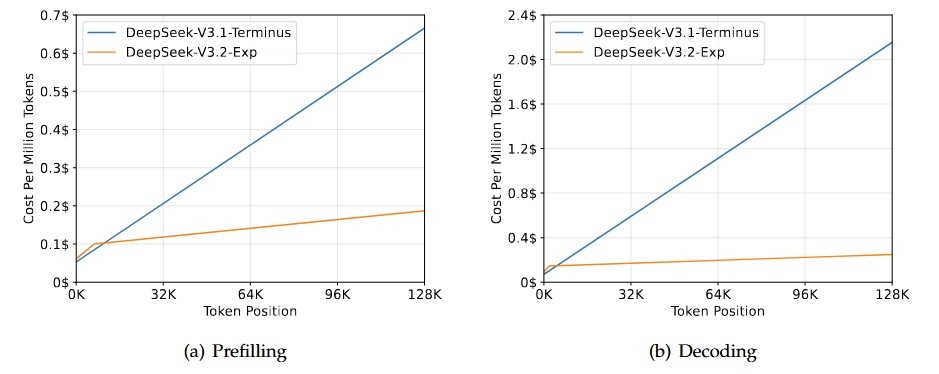
- cost figure 来自 DeepSeek 自身 H800 service benchmark,正式报告和 precursor asset 都没有机器可读数值表;这里保留曲线和方向性解读,不从图像反推精确吞吐。
- scalable GRPO 没有披露完整 batch、rollout width、clip、KL、optimizer、硬件与 wall-clock 配置;报告支持机制与训练可行性,无法复原完整 RL recipe。
- agent benchmark 部分使用内部搜索、Playwright 或 agent harness;thinking context management 与框架消息角色耦合,跨模型对照需要同时审计工具、prompt、timeout、上下文管理和输出长度。
- Speciale 放宽 length penalty、只使用 reasoning data,并且模型卡说明其不支持 tool calling;它与正式 DeepSeek-V3.2 代表不同的能力与成本取舍。
证据写法:
- 论文事实:arXiv
2512.02556v1的公式、表格、图,以及 V3.2-Exp 官方代码直接给出的结构、配置与结果。 - 作者主张:报告对“质量保持”“训练稳定”和“端到端加速”的归因。
- 本地分析:层内共享与跨层独立的实现解释、训练目标盲区、复杂度边界和跨论文比较。
论文脉络
1. 研究问题、背景和价值
报告把开放模型在复杂任务上的差距拆成三类约束。第一,128K context 下的 dense MLA core attention 仍随序列长度二次增长,长 prompt、长 reasoning 与多轮工具轨迹会同时推高训练和部署成本。第二,post-training compute 扩大后,rollout-policy mismatch、training-inference logprob 差异、MoE routing 漂移和 top-p / top-k action-space 不一致会积累成 RL 稳定性问题。第三,agent 能力需要大量可执行、可验证且覆盖长尾工具组合的交互任务,真实用户轨迹和人工构建环境难以直接扩展到所需规模。
DeepSeek-V3.2 对应建立三条路径:用 DSA 降低长上下文 core attention 成本,用 scalable GRPO 约束扩展 RL 时的偏移,用真实与合成 agent 环境把 reasoning 接入工具调用。它的价值来自三者组合:attention efficiency 提供更长 rollout 的计算空间,稳定 RL 吸收大规模 post-training compute,环境与任务合成提供 agent 学习信号。
2. 已有解决方案与不足
在架构侧,固定窗口、局部块稀疏、压缩注意力和 recurrent / linear attention 都能降低长序列成本;它们分别面临远距离证据漏选、压缩损失或与原 softmax attention 能力差异。DSA 保留 MLA 的 selected softmax,通过可训练 indexer 先筛到 token-level top-k。
在 RL 侧,标准 GRPO 配合大 rollout batch 与多 minibatch 更新会逐渐偏离 sampling policy;独立的 inference / training engine、MoE routing 差异和 sampling truncation 进一步扩大 mismatch。DeepSeek 将这些来源分别映射到 unbiased KL、sequence masking、routing replay 和 sampling-mask replay。
在 agent 数据侧,真实 code/search/interpreter 环境具有可执行反馈,但覆盖范围受现有 repository、网页问题和任务来源限制;纯合成任务便于扩展,却容易形成无效工具、不可验证答案或过于简单的任务。报告用环境数据库、受限工具接口、solution / verifier functions、难度迭代和 pass@100 过滤建立可验证合成闭环。
3. 作者可能的思考路径
- 从 V3.1-Terminus 128K checkpoint 出发,用 dense attention 作为 selector teacher,再通过 sparse continued pre-training 适配 top-k 可见集合。
- 在统一 specialist distillation + mixed RL 阶段持续增加 post-training compute,同时把观察到的 mismatch 来源逐项写进 GRPO protocol。
- 先用 reasoning data 与 non-reasoning agent data 构造 thinking-tool cold start,再用真实 search/code/interpreter 环境扩大有效轨迹。
- 对长尾 tool-use,自动生成数据库、工具、任务、solution 与 verifier,并通过可解性过滤保留适合 RL 的环境。
- 推理端保留 tool call 之间的 reasoning;轨迹接近 128K 上限时比较 summary、history discard 与 parallel rollout,检验 serial test-time scaling。
这条思考路径把模型结构、RL 稳定性和环境供给看成相互依赖的扩展约束:每一部分都服务于更长、更复杂且可训练的 reasoning-agent trajectory。
4. 核心假设或切入点
报告包含三组核心假设:
- selector 条件:lightning indexer 的 score 与 dense attention 的重要性排序足够一致。
- adaptation 条件:主模型能通过 sparse continued pre-training 适配被裁剪后的可见上下文。
- kernel 条件:indexer 与 sparse attention 的实际实现成本低于 dense MLA path,并且 top-k、RoPE、KV layout 等细节稳定可复现。
- RL 条件:off-policy negative trajectories 和执行路径不一致是长时间 GRPO 的主要不稳定来源;KL 修正、sequence masking、routing 与 sampling mask replay 可以分别限制这些误差。
- agent-data 条件:hard-to-solve / easy-to-verify 的工具任务可以自动合成,并把在合成环境中学到的策略迁移到未见工具和真实 agent benchmark。
- context 条件:tool output 到达后保留已有 reasoning 能减少重复推理;接近长度上限时,通过 summary 或 history discard 释放上下文可以继续扩大 serial test-time compute。
5. Indexer、selector 与 selected softmax
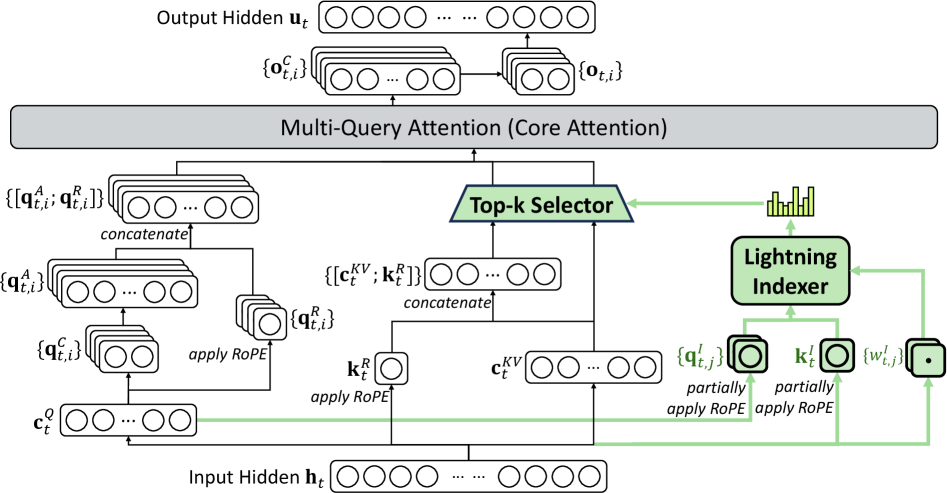
DSA 在每个 attention 层执行三步:lightning indexer 为 causal positions 打分,selector 取 top-k token positions,core attention 在这组位置上重新做 softmax。报告省略了层下标;为了说明跨层语义,这里把第
| 层次 | 实际对象 | 结果 |
|---|---|---|
| Lightning indexer | query token 与每个 causal token position 的轻量相似度 | 当前位置及历史位置各得到一个标量 |
| Top-k selector | 对位置维度排序 | 每层、每个 query 得到 |
| Core attention | 当前层对应位置的 MLA latent KV entries | 在 selected set 内重新归一化 softmax,集合外位置的 attention weight 为 0 |
官方配置给出 64 个 indexer heads、128 维 index head 和 index_topk=2048。多个 indexer heads 在 ReLU 后通过 query-dependent 权重汇成一个位置分数,因此它们用于形成一组候选位置,没有为 128 个 core attention heads 分别产生 128 组 top-k。
Reference code 实际执行 min(index_topk, end_pos):当当前位置之前可见 token 少于 2048 时,所有 causal positions 都进入 core attention;序列超过该阈值后才形成固定上限的稀疏集合。
证据定位:arXiv 2512.02556v1 Section 2.1,Equations 1-2,Figure 2;官方代码 inference/config_671B_v3.2.json 与 inference/model.py -> Indexer.forward,快照 87e509a。

6. “共享 top-k”具体共享什么
共享范围需要按层区分:
- 同一层、同一 query token:indexer 返回的
topk_indices没有 core attention head 维度。代码把同一个 index mask broadcast 到该层 128 个 query heads,因此这些 heads 访问相同的 token positions。 - 不同 Transformer 层:每个
Block创建自己的MLA,每个MLA再创建自己的Indexer、kv_cache与pe_cache。所以与 可以不同,selector 参数和当前层 KV 也彼此独立。 - 相同 token position 被多层选中时:第
层读取 ,第 层读取 。共享的是序列位置编号 ,各层没有共享同一份 KV tensor。
一个直观表示是:
位置 17 同时出现只说明两层都认为该历史 token 相关。两层使用各自经过层变换后的 latent KV 表示。后续 FlashMemory 为物理 KV residency 构造跨代表层的 union mask,属于 serving memory policy;V3.2 的 DSA 没有把各层 top-k 合并成全局 attention set。
证据定位:官方代码 inference/model.py -> Indexer.forward 的 topk_indices、MLA.forward 的 index_mask.unsqueeze(2),以及 Block.__init__ / Transformer.__init__ 的逐层实例化,快照 87e509a。
7. MQA mode 与 masked MHA prefill
MLA 的 MHA mode 与 MQA mode 是同一组 MLA 参数的两种等价计算路径。DSA 把选择单元定义为 latent KV entry:一个历史位置的 latent vector 被当前 query token 的所有 query heads 共享,因此 selector 只需返回一组 positions。
- Decode reference path 采用 MQA mode:把 MLA up-projection 权重吸收到 query/output 侧,直接对 latent KV cache 做 attention。
- Prefill reference path 会先展开 head-specific K/V,以 masked MHA 形式执行;同一
index_mask仍广播给全部 heads,所以逻辑可见集合保持一致。 - 正式报告进一步说明,短序列 prefill 使用 masked MHA 来模拟 DSA,以取得更适合短 context 的 kernel 效率。
因此,MQA mode 描述的是层内 latent KV entry 如何被多个 query heads 共享,以及 core attention 如何重写计算。它不表示不同 Transformer 层共享 selector、top-k set 或 KV cache。
证据定位:arXiv 2512.02556v1 Section 2.1、Section 2.3、Appendix A、Figure 7;官方代码 MLA.forward 的 MHA prefill / MQA decode 两条分支。
8. 复杂度与真实执行成本
对长度为
端到端路径更接近:
Indexer 的打分原语确实仍是 query-key 点积,并且每个 query 都要扫描全部
因此,收益条件更准确地写成:
官方配置可以提供一个 MHA-style 的直观量级:dense core 的每个历史位置约包含
官方 model.py 是语义参考实现,其中可见先形成 dense core scores、再应用 index_mask 的写法。生产收益需要 DeepGEMM indexer kernel 与 FlashMLA sparse attention kernel 在物理执行上只对 selected KV 完成 core attention;若执行引擎仍先算完整 core scores 再 mask,主要计算节省不会兑现。
所以
证据定位:arXiv 2512.02556v1 Section 2.3 Inference Costs;官方配置 inference/config_671B_v3.2.json;官方代码 inference/model.py -> Indexer.forward / MLA.forward;官方 README 的 TileLang、DeepGEMM 和 FlashMLA kernel 入口,快照 87e509a。
9. Scalable GRPO 的四个一致性控制
DeepSeek-V3.2 继续使用 GRPO,并把扩大 RL compute 时观察到的偏移拆成四类控制。它们作用于不同层级:KL estimator 修正 token-level regularization gradient,sequence mask 决定整条负 advantage trajectory 是否进入更新,keep routing 固定 MoE 参数子空间,keep sampling mask 固定 rollout 与训练的合法 action set。
| 机制 | 保存或计算的信号 | 处理的偏移 | 更新效果 |
|---|---|---|---|
| Unbiased KL Estimate | 通过 current / old policy importance ratio 修正 K3 estimator | 从 old policy 采样时,直接使用原 K3 所产生的 gradient bias | 报告主张获得 unbiased KL gradient;不同任务可以使用不同 KL 强度,数学任务可采用很弱或零 KL |
| Off-Policy Sequence Masking | inference engine 返回的 sampling logprob 与 current policy 之间的 sequence divergence | 大 rollout batch、多 minibatch 更新与 train-rollout engine 差异共同形成的 off-policy 程度 | 只对 negative-advantage 且 divergence 超阈值的 sequence 置零;positive sequence 与低 divergence negative sequence继续训练 |
| Keep Routing | rollout 时每个 token 的 MoE expert routing path | policy 更新或引擎数值差异让同一 token 在训练时进入另一组 experts | trainer 重放 rollout routing,使被更新的 active expert parameters 与采样路径一致 |
| Keep Sampling Mask | rollout 时 top-p / top-k 截断后的 token support | old policy 从截断分布采样,而 current policy loss 仍在完整词表归一化 | trainer 对 current policy 应用同一截断 mask,使 importance sampling 的 action space 对齐 |
这四项形成一条由概率分布到执行路径的 consistency chain。Off-Policy Sequence Masking 是非对称启发式:高偏移正 advantage trajectory 仍被保留,高偏移负 trajectory 才被过滤。公开报告没有给出 divergence threshold、各 domain KL 系数、mask rate、单项 ablation 或多 seed 曲线,因此现有证据支持“生产 recipe 采用这些控制”,对每一项的独立因果贡献仍需复验。
证据定位:arXiv 2512.02556v1 Section 3.1 Scaling GRPO,Equations 5-9;Keep Routing 说明该机制自 DeepSeek-V3-0324 起进入内部 RL pipeline。
10. Thinking tool-use 与 agent task synthesis
Thinking tool-use 先处理轨迹表示。工具结果追加到 tool role 时,模型保留已有 reasoning,使后续步骤可以沿用当前计划;新用户消息进入时,历史 reasoning 被移除,tool calls 与 tool results 继续保留。这条规则依赖消息角色语义。Roo Code 或 Terminus 若把工具交互模拟成 user message,会提前触发 reasoning 清理,报告因此建议这些框架优先使用 non-thinking mode。
Cold start 把两类已有数据组合起来:reasoning data 提供 <think>...</think> 轨迹,non-reasoning agent data 提供工具定义与调用格式;联合 system prompt 要求模型在 reasoning 中穿插多轮 tool calls。初始轨迹只需偶尔满足目标格式,后续 RL 再提高鲁棒性。
大规模 agent RL 数据覆盖四类任务:
| 类型 | Prompt / task 数 | 环境 | Prompt 来源 | 主要构造方式 |
|---|---|---|---|---|
| Code agent | 24,667 | 真实 | 抽取 | 从 GitHub issue-PR pairs 构建可执行 repository;gold patch 必须产生 F2P 且保持 P2F=0 |
| Search agent | 50,275 | 真实 search API | 合成 | long-tail entity -> question agent -> heterogeneous answer agents -> multi-pass search verifier |
| Code interpreter | 5,908 | 真实 Jupyter | 抽取 | 数学、逻辑和数据科学任务要求通过代码执行求解 |
| General agent | 4,417 tasks / 1,827 environments | 合成 | 合成 | 构建数据库和 function tools,再共同生成 task、solution function 与 verifier function,逐步增加难度 |
General-agent synthesis 的关键约束是 solution function 只能调用公开工具或执行逻辑计算,不能绕过工具直接读取数据库;verifier 必须接受 solution 输出。RL 前再用 DeepSeek-V3.2 执行 pass@100 过滤,只保留至少存在成功轨迹的环境。这个流程同时控制可验证性和可学习性,也会排除当前模型完全无法探索到成功路径的任务。
报告还在 search agent 测试阶段加入长度触发的 context management:token usage 超过 128K window 的 80% 后,分别测试 summary、discard first 75% tool history、discard all history,并与并行采样后选择最少步骤轨迹比较。这属于 test-time serial scaling,与训练时“tool return 后保留 reasoning”的消息管理规则是两个不同机制。
证据定位:arXiv 2512.02556v1 Sections 3.2.1-3.2.3,Table 1,Appendix B;test-time context management 见 Section 4.4、Figure 6。
11. DSA continued pre-training
continued pre-training 由两个阶段组成,数据分布与 V3.1-Terminus 的 128K long-context extension data 对齐。
| 阶段 | 训练对象 | Attention pattern | 目标 | 关键配置 |
|---|---|---|---|---|
| Dense warm-up | 只训练 lightning indexer;冻结主模型 | dense attention | 用 dense main attention 分布监督 indexer | LR 1e-3;1000 steps;每步 16 条 128K sequences;合计 2.1B tokens |
| Sparse training | 训练主模型与 indexer | DSA top-k sparse attention | 主模型适配稀疏可见集合;indexer 继续对齐选中集合上的 main attention 分布 | LR 7.3e-6;top-k = 2048 KV tokens/query;15000 steps;每步 480 条 128K sequences;合计 943.7B tokens |
Dense warm-up 的 teacher signal 来自主模型 dense attention:先把所有 attention heads 上的主 attention scores 求和,再沿 sequence dimension 做 L1 normalize,得到目标分布 p_{t,:}。indexer 用 KL loss 对齐:
Sparse training 只在 selected set S_t 上继续对齐:
报告中特别说明:indexer input 从 computational graph 中 detach,indexer 只由
公式还留下一项实现歧义。
证据定位:arXiv 2512.02556v1 Section 2.1.1,Equations 3-4;训练配置见 Dense Warm-up Stage 与 Sparse Training Stage。关于归一化和集合外梯度的说明属于本地分析。
12. Post-training、模型变体与 RL
DSA continued pre-training 后,正式 DeepSeek-V3.2 继续使用 sparse attention,并采用 specialist distillation + mixed RL。报告称 post-training compute 已超过 pre-training cost 的 10%;这个比例属于作者披露,缺少统一 FLOP accounting、硬件和 wall-clock 明细。
Post-training 包含两部分:
| 部分 | 做法 | 说明 |
|---|---|---|
| Specialist distillation | 从同一个 sparse continued-pretrained base checkpoint 训练领域 specialist,再用 specialist 生成 final checkpoint 的领域数据 | 覆盖 writing、general QA、mathematics、programming、logical reasoning、general agent、agentic coding、agentic search;thinking 与 non-thinking 分别产数 |
| Mixed RL | 使用 GRPO,把 reasoning、agent、human alignment 合并到一个 RL stage | reasoning / agent tasks 使用 rule-based outcome reward、length penalty、language consistency reward;general tasks 使用 per-prompt rubric 的 generative reward model |
最终提供两个变体。DeepSeek-V3.2 混合 reasoning、agent 与 human-alignment data,并保留更强的长度约束,以平衡准确率、token cost 与 tool use。DeepSeek-V3.2-Speciale 只使用 reasoning data,降低 RL length penalty,并吸收 DeepSeekMath-V2 的 proof data / reward;它允许更长输出,模型卡明确说明不支持 tool calling。二者共享架构,训练目标和产品能力边界不同。
报告没有给出 rollout infrastructure、group size、batch size、clip range、各 domain KL 系数、训练卡数或 RL wall-clock。Scalable GRPO 公开了主要稳定性机制,完整可复现 recipe 仍然缺失。
证据定位:arXiv 2512.02556v1 Section 3 Post-Training、Section 3.1 Scaling GRPO;V3.2-Exp 的两项 RL curve 见 2025-09-29 precursor report Section 3、Figure 2。
13. 结论链条
- Dense MLA 的历史 attention mass 若集中在少量位置,轻量 indexer 就有机会学习其排序结构。
- Dense warm-up 先给 selector 一个全历史 teacher,避免从随机 top-k 直接进入不可微集合选择。
- Sparse continued pre-training 让主模型在 2048-token 可见集合上重新适配;943.7B token 预算说明这次架构替换包含大规模能力恢复过程。
- H800 service 曲线表明节省的 dense core attention 在长 token position 上超过 indexer、top-k 和 gather 成本,为更长 reasoning / agent rollout 提供更低的 attention path 成本。
- Scalable GRPO 把 token distribution、sequence inclusion、MoE routing 与 sampling support 四层一致性同时纳入训练协议,支撑作者所述的长期 mixed RL。
- Thinking-tool cold start 提供初始交互格式,真实 code/search/interpreter 环境和可验证合成环境提供大规模 RL 任务;合成任务 ablation 给出跨未见 benchmark 的迁移信号。
- Context management 在 128K 上限附近继续扩展 serial test-time compute,Speciale 则通过更弱 length penalty 扩大 reasoning token budget;两者都说明准确率需要与 token、step 和 harness 成本共同比较。
- 报告最窄可支持的整体结论是:在 DeepSeek 内部模型、数据、RL 与 serving 栈下,DSA、稳定性控制和 agent task synthesis 可以共同形成高能力 128K reasoning-agent model。各组件的独立贡献、完整训练成本和跨引擎复现仍需额外实验。
关键实验/定理
结果 1:DSA 替换后的 benchmark 质量基本贴近 V3.1-Terminus
- 设置:DeepSeek-V3.1-Terminus vs DeepSeek-V3.2-Exp;V3.2-Exp 在 V3.1-Terminus 128K checkpoint 上通过 DSA continued training 与相同 post-training pipeline 得到。
- Baseline:DeepSeek-V3.1-Terminus 是同源前代强基线。
- 指标:通用、搜索 agent、代码、代码 agent、数学 benchmark。
- 结果:多数任务持平或小幅波动;GPQA-Diamond、Humanity's Last Exam、HMMT 2025 较低,报告解释为 V3.2-Exp 生成 reasoning tokens 更少,使用 comparable token length 的 intermediate checkpoints 时差距会缩小。
- 证据定位:2025-09-29 PDF Section 3、Table 1。
- 对照是否可比:初始化来源和 post-training pipeline / algorithm / data 按作者披露保持一致;V3.2-Exp 额外接受 2.1B + 943.7B token continued pre-training,缺少同等 compute 的 dense continuation control。
- 支持的最窄结论:完整训练后的 V3.2-Exp 在这组公开 benchmark 上与 V3.1-Terminus 接近。该表无法单独估计“只替换 attention、训练预算不变”时的因果效果。
- 解读:输出长度是 reasoning 结果的混杂变量。作者提到 comparable-length intermediate checkpoints 会缩小差距,但没有公开这些 checkpoint 的逐项表格,所以这项归因按作者解释保留。
| Benchmark | Metric | V3.1-Terminus | V3.2-Exp | Delta | 备注 |
|---|---|---|---|---|---|
| MMLU-Pro | EM | 85.0 | 85.0 | 0.0 | 持平 |
| GPQA-Diamond | Pass@1 | 80.7 | 79.9 | -0.8 | 报告称与较短 reasoning tokens 相关 |
| Humanity's Last Exam | Pass@1 | 21.7 | 19.8 | -1.9 | 报告称 comparable token length checkpoint 可缩小差距 |
| BrowseComp | Acc. | 38.5 | 40.1 | +1.6 | search agent 提升 |
| BrowseComp-zh | Acc. | 45.0 | 47.9 | +2.9 | search agent 提升 |
| SimpleQA | Acc. | 96.8 | 97.1 | +0.3 | 小幅提升 |
| LiveCodeBench 2408-2505 | Pass@1 | 74.9 | 74.1 | -0.8 | 小幅下降 |
| Codeforces-Div1 | Rating | 2046 | 2121 | +75 | 提升 |
| Aider-Polyglot | Acc. | 76.1 | 74.5 | -1.6 | 下降 |
| SWE Verified | Agent mode | 68.4 | 67.8 | -0.6 | 小幅下降 |
| SWE-bench Multilingual | Agent mode | 57.8 | 57.9 | +0.1 | 持平 |
| Terminal-bench | Terminus 1 framework | 36.7 | 37.7 | +1.0 | 提升 |
| AIME 2025 | Pass@1 | 88.4 | 89.3 | +0.9 | 提升 |
| HMMT 2025 | Pass@1 | 86.1 | 83.6 | -2.5 | 报告称与较短 reasoning tokens 相关 |
结果 2:RL training curves 显示 sparse attention 后训练未明显失稳
- 设置:比较 V3.1-Terminus 与 V3.2-Exp 在 BrowseComp 与 SWE Verified 上的 RL training curves。
- Baseline:V3.1-Terminus。
- 指标:accuracy 与 average output tokens,训练曲线约覆盖 0 到 1400 steps。
- 结果:两个模型的 accuracy 都随训练推进而上升,曲线较接近。
- 证据定位:2025-09-29 PDF Section 3、Figure 2。
- 对照是否可比:两条曲线来自同系列模型与作者声称相同的 RL pipeline,任务和 step axis 对齐;报告没有给出 seed、误差带、rollout backend、batch size 或完整 GRPO 配置。
- 支持的最窄结论:在这两项任务和这次训练 run 中,DSA checkpoint 的 accuracy / output-length trajectory 没有出现肉眼可见的系统性崩溃。
- 解读:该图提供训练可行性信号,证据强度不足以推出 DSA 在任意 RL engine、top-k kernel 或随机种子下都稳定。
结果 3:长上下文 inference cost 明显下降
- 设置:实际 service 部署在 H800 GPU clusters;按 H800 租用价 2 USD / GPU hour 估算 token cost;比较 token position 0K、32K、64K、96K、128K 下的 prefill 与 decoding cost。
- Baseline:DeepSeek-V3.1-Terminus。
- 指标:Cost per million tokens。
- 结果:正式报告 Figure 3 显示 DeepSeek-V3.2 在长 token position 下的 prefill 和 decoding cost 曲线明显低于 V3.1-Terminus;短位置存在 selector / sparse path 开销与成本交叉区间,收益随 token position 增长而扩大。
- 证据定位:arXiv
2512.02556v1Section 2.3、Figure 3;前置仓库cost.jpg。 - 对照是否可比:同一 H800 租价口径与同系列模型提高了内部比较可比性;报告没有披露 batch、并发、TP/DP/EP、SLO、prompt mix、输出长度、功耗或重复次数。
- 支持的最窄结论:在 DeepSeek 的 H800 service 配置与美元换算口径下,DSA 降低了 128K 长位置 token 的 GPU-time cost。图中指标不能直接替代 latency、throughput 或跨硬件成本结论。
- 解读:曲线支持“省下的 dense core attention 逐渐超过 indexer/top-k/gather 开销”。作者为短序列 prefill 另用 masked MHA path,也说明 sparse execution 需要按序列长度选择 kernel。

cost.jpg at 87e509a.结果 4:后续公开评测没有显示明显长上下文回退
- 设置:2025-12 的正式 DeepSeek-V3.2 报告回顾 V3.2-Exp release,补充 2025-11-10 ChatbotArena Elo、Artificial Analysis Long Context Reasoning(AA-LCR)和 Fiction.liveBench。
- Baseline:DeepSeek-V3.1-Terminus。
- 指标:ChatbotArena Elo 和两项第三方 long-context evaluation。
- 结果:报告称两代模型 ChatbotArena Elo 接近;V3.2-Exp 在 AA-LCR reasoning mode 高 4 分,并在 Fiction.liveBench 多项指标上领先。
- 证据定位:DeepSeek-V3.2 arXiv v1 Section 2.2
Parity Evaluation。 - 对照是否可比:这些评测发生在 release 后并使用此前未见测试集,能减少原报告内部 benchmark 的同源性;正式报告只给摘要式描述,没有完整复现实验设置、逐项表格或不确定性。
- 支持的最窄结论:截至 2025-11,选取的外部公开评测没有暴露 V3.2-Exp 相对 V3.1-Terminus 的明显长上下文退化。这项后验观察无法证明所有 long-context workload 都保持质量。
- 解读:后续证据提高了“DSA retrofit 没有系统性破坏长上下文能力”的可信度,同时仍需要 selector recall、层级失败案例和统一 harness 下的直接测量。
结果 5:正式 V3.2 同时提升 reasoning、code/search agent 与 tool-use
- 设置:DeepSeek-V3.2 与 Claude-4.5-Sonnet、GPT-5 High、Gemini-3.0-Pro、Kimi-K2 Thinking、MiniMax-M2 Thinking 比较;tool-use 使用 thinking mode、temperature 1.0、128K context。
- Baseline:包含开放与闭源同期强模型;不同模型使用的 agent framework、search API、tool role、prompt 和 context management 仍有差异。
- 结果:DeepSeek-V3.2 在 LiveCodeBench 为 83.3、AIME 2025 为 93.1、SWE Verified 为 73.1、SWE Multilingual 为 70.2、BrowseCompZh 为 65.0、MCP-Universe 为 45.9、MCP-Mark 为 38.0。BrowseComp 从无 context management 的 51.4 提升到 67.6。
- 证据定位:arXiv
2512.02556v1Section 4.1、Table 2;non-thinking 对照见 Appendix C、Table 9。 - 对照是否可比:reasoning benchmark 的 prompt 和部分采样参数披露较清楚;MCP / search / coding agent 使用内部或模型特定 harness,BrowseComp 67.6 还包含 V3.2 专属 context management。
- 支持的最窄结论:在报告采用的评测栈下,V3.2 达到同期强开放模型水平,并在多项 code/search/tool benchmark 上接近部分闭源模型。该表无法把增益单独归因给 DSA、RL compute、合成任务或 context management。
结果 6:合成 general-agent tasks 提供跨环境迁移信号
- 设置:先从合成 general-agent 数据随机抽取 50 个 task 测量难度;再从 DeepSeek-V3.2-SFT 出发,只用 non-thinking synthetic agent tasks 做 RL,并在 Tau2Bench、MCP-Mark、MCP-Universe 上评测。
- Baseline:难度测试包含 V3.2-Exp、Sonnet-4.5、Gemini-3.0-Pro、GPT-5-Thinking;迁移测试包含 V3.2-SFT 和只在 code/search 环境做 RL 的 V3.2-Exp。
- 结果:50-task 样本上,V3.2-Exp Pass@1 为 12%,三种闭源模型最高为 62%,说明样本包含较难任务。Figure 5 显示 synthetic-only RL 相对 SFT 在三个未见 benchmark 上均提升,code/search-only RL 没有产生同方向提升。
- 证据定位:arXiv
2512.02556v1Section 4.3、Table 5、Figure 5。 - 对照是否可比:只使用 synthetic data 的隔离实验提高了归因强度;报告没有给出 Figure 5 的机器可读数值、训练 compute、seed、方差和等量真实环境 RL 对照。
- 支持的最窄结论:在该 checkpoint 和训练设置下,自动合成 general-agent tasks 学到的策略可以迁移到三个未见 agent benchmark。任务覆盖广度与现实用户分布仍未建立。
结果 7:Context management 与 Speciale 展示两种 test-time compute 扩展
- 设置:BrowseComp 在 token usage 超过 128K 的 80% 时触发 Summary、Discard-75%、Discard-all,并与并行采样后选最少步骤轨迹比较;Speciale 则放宽 RL length penalty,在 reasoning benchmark 与竞赛协议下评测。
- 结果:V3.2 BrowseComp 无 context management 为 51.4,Summary 报告到 60.2,Discard-all 达到 67.6;报告称 Discard-all 的步数低于达到相近分数的 parallel scaling。Speciale 在 AIME 2025 为 96.0、IMOAnswerBench 为 84.5、LiveCodeBench 为 88.7,并报告 IMO 35/42、IOI 492/600 的 gold-medal-level 结果。
- 证据定位:arXiv
2512.02556v1Sections 4.2、4.4,Tables 3-4,Figure 6,Appendix D。 - 对照是否可比:BrowseComp 比较需要同时计入平均 steps、summary 调用和被丢弃上下文成本;Speciale 的输出明显更长。竞赛评测使用 128K 最大生成长度,IOI 每题先采样 500 个 candidates 再筛到最多 50 次提交,ICPC 每题采样 32 个 candidates,IMO / CMO 使用 generate-verify-refine。
- 支持的最窄结论:serial context reset 和更长 reasoning 都能提升特定任务分数,收益伴随额外 token、轨迹或候选搜索成本。它们提供 test-time scaling 证据,不能按单次生成能力解读。
实验设置与 baseline 审计
数字密集项优先用表格记录,正文保留判断和边界。
| 维度 | 记录 |
|---|---|
| 模型与初始化 | 从 context length 已扩到 128K 的 DeepSeek-V3.1-Terminus base checkpoint 开始 DSA continued pre-training;V3.2-Exp 是 2025-09 前置发布,正式 V3.2 在相同架构上完成 specialist distillation 与 mixed RL。 |
| 架构改动 | 报告称相对 V3.1-Terminus 的唯一架构改动是引入 DeepSeek Sparse Attention。DSA 由 lightning indexer 与 fine-grained token selection 组成。 |
| DSA top-k | 每个 attention 层、每个 query token 最多选择 2048 个 token positions;可见长度不超过 2048 时保留全部 causal positions。该层 128 个 query heads 共享 positions,不同层独立选择并读取各自 latent KV。 |
| Indexer architecture | 官方配置为 64 index heads、head dimension 128;各层独立实例化 Indexer。index heads 聚合成每个历史位置一个 scalar score。 |
| 数据与任务 | continued pre-training 两阶段的数据分布与 V3.1-Terminus 的 128K long-context extension data 完全对齐;具体数据来源、配比和去重策略未披露。 |
| Dense warm-up | 冻结主模型,只训练 indexer;dense attention;LR 1e-3;1000 steps;每步 16 条 128K sequences;总计 2.1B tokens。 |
| Sparse continued pre-training | 引入 top-k sparse selection,训练主模型与 indexer;LR 7.3e-6;15000 steps;每步 480 条 128K sequences;总计 943.7B tokens。 |
| Indexer loss | dense warm-up 在全序列上用 |
| Gradient / detach | sparse training 中 detach indexer input;indexer 只吃 L_I,主模型只吃 LM loss。 |
| Post-training | 与 V3.2-Exp 使用相同 specialist distillation + mixed RL 框架;specialists 覆盖 writing、QA、math、programming、logic、general agent、coding agent 和 search agent。 |
| RL 配置 | 采用 GRPO;reasoning / agent tasks 使用 rule-based outcome reward、length penalty、language consistency reward;general tasks 使用 per-prompt rubric 的 generative reward model。Scalable GRPO 增加 unbiased KL、off-policy negative-sequence masking、keep routing、keep sampling mask。 |
| Agent task 数据 | Code 24,667、search 50,275、code interpreter 5,908、general agent 4,417;前三类使用真实执行环境,general agent 来自 1,827 个合成环境。具体去重、train split、rollout 次数和各域混合比例未披露。 |
| Thinking context | tool message 到达时保留 reasoning;新 user message 到达时清理历史 reasoning,同时保留 tool calls / results。框架若把 tool output 编码成 user message,会改变该策略行为。 |
| 模型变体 | V3.2 混合 reasoning / agent / alignment data 并加强长度约束;Speciale 只使用 reasoning data、减弱 length penalty、加入 DeepSeekMath-V2 proof recipe,模型卡说明不支持 tool calling。 |
| 训练硬件与拓扑 | 未披露训练卡型、卡数、集群拓扑、interconnect、pipeline / tensor / data / expert parallel 配置。 |
| 并行方式与框架 | 报告未披露训练框架和并行策略;README inference 示例暴露 MP model-parallel 转换、SGLang tp 8 / dp 8 / --enable-dp-attention 启动口径,这些属于 inference/run-local surface,不能反推训练配置。 |
| 框架基座 / paper base | 模型基座是 DeepSeek-V3.1-Terminus 128K MLA checkpoint;训练框架未披露;公开 inference demo 是 custom PyTorch reference path,生产 kernel 入口包括 DeepGEMM、FlashMLA 和 TileLang。 |
| 框架版本与证据来源 | project main@87e509a;官方 PDF、README、inference/model.py、config_671B_v3.2.json;生产 serving engine 和 kernel release 组合没有形成单一可复现版本清单。 |
| 框架改动范围 | 模型层新增 per-layer indexer、top-k mask 与 sparse core attention;reference code 同时实现 masked MHA prefill 和 MQA decode;生产路径新增 indexer logit、paged variant 和 sparse FlashMLA kernel。 |
| Kernel / implementation | indexer 支持 FP8;reference code 显示 64-head indexer、layer-local caches、head-shared mask 和非交错 indexer RoPE。README 指向高性能 kernel,但没有公开完整 production scheduler / serving configuration。 |
| 训练时间 / GPU hours / 成本 | DSA continued pre-training token 数披露;作者称 post-training compute 超过 pre-training cost 的 10%。训练 wall-clock、GPU hours、统一 FLOPs 口径和美元成本未披露。 |
| Inference cost 口径 | H800 GPU clusters 实际 service benchmark;按 2 USD / GPU hour 估算 cost per million tokens;图中覆盖 prefill 与 decoding。该指标是 GPU-time 的美元代理,无法直接给出 latency、throughput 或能耗。 |
| 评测协议 | 主表覆盖 general、reasoning、code/search agent 与 tool-use;tool-use 为 thinking mode、temperature 1.0、128K context。MCP 使用内部环境,Terminal Bench 使用 Claude Code / Terminus,SWE 与 search 使用内部或多个 framework 复验。Speciale 竞赛结果包含候选采样与筛选。 |
| 统计报告 | 没有置信区间、seed、方差或显著性检验。 |
| Baseline 是否 tuned | DSA parity 使用同源 V3.1-Terminus 强基线;正式模型主表包含同期强开放与闭源模型,但各自 agent harness 和 test-time compute 不完全一致。 |
| Baseline 是否 compute-matched | DSA 质量比较缺少同等 945.8B token dense continuation;正式模型比较缺少等 post-training FLOPs、等输出 token、等 agent steps 和统一 context-management control。 |
| Baseline 是否 implementation-matched | 同源模型与同 post-training pipeline 支持 implementation alignment;DSA 需要新 indexer、top-k selector 和 sparse kernels,implementation surface 更复杂。 |
| Baseline 是否覆盖强替代方案 | 未与 MiniMax Sparse Attention、Native Sparse Attention、sliding-window / block-sparse / compressed attention、linear attention 等替代方案做同模型对照。 |
| Baseline 是否存在弱化风险 | V3.1-Terminus 是强架构基线;闭源主表 baseline 也较强。输出长度、candidate search、tool framework、内部环境和 context management 形成主要比较偏差。 |
| 结论边界 | 证据支持 DeepSeek 内部完成高质量 DSA retrofit,并用 scalable GRPO 与大规模 agent tasks 得到强 V3.2 checkpoint。各组件独立贡献、完整成本和跨引擎外推需要额外复验。 |
证据链强度评估
强证据
- DSA 机制、loss、top-k、训练步数、token 数、学习率和 detach 逻辑在报告中清楚披露。
- 官方 reference code 直接显示 per-layer indexer、head-shared top-k mask、layer-local KV cache、masked MHA prefill、MQA decode 和 indexer 非交错 RoPE,可用于核对逻辑语义。
- 模型权重、配置和 kernel 入口公开,能够复查
index_n_heads=64、index_head_dim=128、index_topk=2048及关键算子边界。 - 正式报告明确列出四类 agent task 的数量、真实/合成环境来源、code environment 验收条件和 general-agent synthesis 的 solution / verifier 约束。
- Scalable GRPO 对四种一致性控制的作用对象和执行方式给出清楚描述,能够区分 token estimator、sequence filter、expert route 与 sampling support。
中等强度证据
- V3.1-Terminus 是同源强基线,benchmark table 支持完整迁移 pipeline 后整体质量基本保持;额外 945.8B continued-training tokens 和缺少 compute-matched dense control 限制了架构因果归因。
- RL training curves 支持训练稳定性,但只有两项任务曲线,缺少 full RL 配置与多 seed。
- H800 cost figure 支持长上下文成本下降,但没有机器可读成本表和端到端 serving 配置细节。
- 正式 V3.2 主表覆盖 reasoning、coding、search 和 tool-use;强 baseline 提高了能力定位价值,内部 harness、输出长度和 test-time compute 差异限制了横向归因。
- Synthetic-only RL 相对 SFT 与 code/search-only RL 的隔离比较支持跨环境迁移;Figure 5 缺少机器可读数值、compute matching 和多 seed。
- Speciale 与 context management 结果支持 test-time compute scaling;candidate sampling、长输出和轨迹重置成本需要进入比较口径。
需要谨慎的推论
- 943.7B sparse adaptation 是这次成功迁移使用的预算,报告没有做 budget ablation,因此它提供充分条件的实例,不构成必要预算下界。GLM-5 后续报告的更小适配预算也提示预算需求会随 checkpoint、数据和训练 recipe 变化。
- Sparse-stage KL 只写到当前 selected set,报告未披露 restricted teacher mass 的归一化方式;集合外 token 缺少直接 selector gradient,dense warm-up recall 和 top-k 稳定性具有关键作用。
- indexer 仍然扫描历史 token;长 context 下的最终瓶颈可能转移到 indexer logit、top-k、KV gather 和 sparse attention kernel。
- README 2025-11-17 记录 indexer RoPE layout bug,说明 DSA 对 RoPE layout、MLA layout 和 indexer path 一致性非常敏感。
- Scalable GRPO 没有逐项 ablation、threshold、mask rate、domain KL、group size 或完整系统配置;四项机制的独立贡献仍属开放问题。
- Pass@100 过滤把 synthetic environment 限制在当前模型至少偶尔能成功的范围,提升可学习性,也会裁掉更远能力边界上的任务。
- 报告没有训练卡数、并行方式、训练成本和完整数据组成;“post-training compute 超过 pre-training cost 10%”无法独立复算。
OpenReview / 审稿意见吸收
- Page type: not-found
- Match confidence: high
- Observed at: 2026-07-14
- Venue status: arXiv technical report
2512.02556v1;无独立会议投稿状态。 - Public reviews: 未发现可匹配的 OpenReview、ARR 或会议公开审稿页。
- Ratings / confidence: 无。
- Reviewer consensus: 无。
- Main criticisms: 不适用;本地证据审计识别出的开放问题包括 indexer bottleneck、完整 RL recipe、agent task 数据审计、内部 harness、test-time compute matching 和组件级 ablation。
- Author response: 无公开审稿回应;README 2025-11-17 对 indexer RoPE discrepancy 做了工程修复说明。
- 对可信度的影响: DSA、scalable GRPO 和 agent synthesis 的机制具有清楚官方来源;整体能力、组件归因和成本外推仍主要依赖内部训练与评测,外部独立复现有限。
本地讨论补充
1. 讨论收敛点
- 当前档案的规范身份是 arXiv
2512.02556v1与正式名称 DeepSeek-V3.2;2025-09-29 V3.2-Exp 是 DSA 的前置发布与实现来源。 - DSA 的全称是 DeepSeek Sparse Attention,由 DeepSeek 在 V3.2-Exp 中先行发布,并在正式 V3.2 报告中完整纳入 architecture;GLM-5 报告中的 DSA 是采用和适配。
- DSA 的“sparse”发生在每层 core attention 的逻辑可见集合:每个 query 先由该层 lightning indexer 对历史 token 打分,再只取 top-k MLA latent KV entries 执行 selected softmax。
- 同一层的全部 query heads 共享一组 top-k token positions,各 Transformer 层独立打分和选择。相同位置被多层选中时,各层读取自己的 latent KV tensor。
- MQA mode 说明 latent KV entry 在层内被多个 query heads 共享;prefill 可以用 masked MHA 做等价执行。这一术语不表示跨层共享 KV cache。
- DSA 与 MiniMax-M3 的 MSA 有相似训练语言:二者都用 trainable selector / index branch 与 KL alignment 处理 sparse softmax attention;DSA 是 token-level MLA latent selection,MSA 是 GQA-based block sparse selection。
- DSA 和 TIM / deterministic inference 的关系在工程层:top-k selector、RoPE layout、kernel path、batch / prefill / decode mode 差异会改变实际可见集合或数值路径;进入 RL rollout 后,这些差异需要用 train-rollout consistency 语言审计。
- Scalable GRPO 的四项控制覆盖不同偏移来源:unbiased KL 处理 estimator gradient,off-policy masking 过滤高偏移负轨迹,keep routing 固定 MoE active parameters,keep sampling mask 对齐截断后的 token support。
- Agent 部分同时包含训练时 reasoning retention、真实 / 合成环境供给和测试时 trajectory reset;三者分别作用于消息表示、RL data distribution 与 test-time compute。
2. 修正后的理解
- MLA 与 DSA 位于同一 attention stack 的不同层级。MLA 定义低秩 latent KV 表示、KV-cache 压缩以及 MHA/MQA 等价计算路径;DSA 在 MLA 上增加 lightning indexer 与 top-
token selection,决定当前 query 可以访问哪些 MLA latent KV entries。DeepSeek-V3.2 因此同时使用 MLA 与 DSA,正式报告将其称为 “instantiate DSA under MLA”。 只描述 core attention。端到端路径仍包含 indexer、top-k、gather、sparse attention 和其它模型计算,成本图用于验证这些项相加后的实际结果。 - Indexer 与传统 attention 都使用 query-key 点积;indexer 将全历史扫描压缩为低成本排序,昂贵的多头 QK、softmax、KV 读取和 value 聚合只覆盖 top-k。128K context、
时,最后一个 query 的 core attention 可见比例为 ,indexer 的全量扫描仍是后续需要继续优化的成本项。 - Dense warm-up 先建立 selector 的全历史排序能力,sparse training 再让主模型适配。943.7B token 是报告采用的充分预算实例,公开材料没有给出最低适配预算。
- 原始 DSA 管理“该层 attention 能看到哪些 token”;FlashMemory 后续管理“哪些 chunk 的各层 KV 需要驻留 GPU”。逻辑选择与物理驻留是相邻的两个系统层级。
- GLM-5.2 的 IndexShare / IndexCache 可以看作 DSA 采用方对逐层 indexer 成本的后续工程回应;它跨层复用 top-
positions,各层仍读取自己的 KV。 - Off-Policy Sequence Masking 只过滤 negative-advantage 且 divergence 超阈值的整条轨迹,属于稳定性启发式;其收益与偏差需要结合 mask rate、正负 advantage 分布和后续 policy drift 测量。
- General-agent pass@100 filter 保证保留任务至少存在一条当前模型可探索到的成功路径,也会把完全超出当前 policy support 的环境排除在训练集之外。
3. 后续复验指标
- indexer top-k recall:top-k set 对 dense attention mass 的覆盖率,按层、head、token position、task 类型分解。
- cross-layer overlap:测量
的 Jaccard overlap、代表层 union 膨胀和共享 indices 对 recall / HBM / latency 的影响。 - long-context quality vs cost frontier:固定输出长度和采样参数,比较 DSA、MSA、CSA/HCA、sliding-window、linear attention。
- rollout/trainer consistency:同 prompt、同 seed、同 temperature 下,indexer top-k set、selected KV ids、logprob、sampled token 是否跨 engine / batch size / prefill chunk 保持一致。
- indexer bottleneck:在 128K、256K、1M context 下分解 indexer logit、top-k、KV gather、sparse attention、MoE 和 sampling 成本。
- scalable GRPO audit:分别记录 KL correction、negative-sequence mask rate、routing replay mismatch、sampling-support size,以及四项机制的单项 / 组合 ablation。
- agent data audit:按环境来源、任务类型、pass@100、工具数和轨迹长度分解训练分布,并在完全未见 tool schema 与真实用户任务上复验迁移。
- context-management accounting:同时报告准确率、模型 token、summary token、tool calls、平均 steps、重启次数、wall-clock 与峰值 context。
主要启发
- 可训练稀疏注意力需要同时设计 selector supervision、层内共享粒度、sparse kernel 和主模型适配预算。
- Dense warm-up + sparse adaptation 把“学会选择”和“适配被选择的信息集合”分成两个阶段;selector 与主模型 loss 分离后,recall、membership drift 和 LM recovery 可以分别诊断。
- 对长上下文模型,性能表需要和 cost table 同时读。V3.2 的 DSA 价值集中在“质量基本保持 + 长位置 token 成本下降”这个组合。
- DSA 把后续工程问题推进到 selector 成本与跨层复用、KV residency 和确定性 top-k,分别连接 GLM-5.2、FlashMemory 与 TIM。
- 大规模 RL 的一致性控制需要覆盖概率估计、样本选择和执行路径;只约束 policy ratio 无法覆盖 MoE routing 与 sampling truncation 的实现差异。
- 可验证环境合成可以同时生成 state、tools、task、solution 和 verifier,再用 policy success filter 调整任务到当前可学习区间;研究价值取决于保留范围与被过滤范围是否共同公开。
- Agent context management 同时改变可用历史和 test-time compute budget,评测时需要把准确率、token、step、tool cost 与重启成本放进同一张表。
局限
- 报告没有披露训练硬件、卡数、并行方式、训练 wall-clock、GPU hours 和完整数据组成;训练成本无法独立核算。
- 质量对照缺少 compute-matched continued training baseline,也缺少与其他 sparse / linear / compressed attention 路线的同模型对照。
- H800 cost figure 没有机器可读数值和完整 serving 配置,外部用户很难复现相同 cost curve。
- Scalable GRPO 没有公开 threshold、mask rate、KL / clip 超参、rollout width、batch size 和组件级 ablation,稳定性因果链仍不完整。
- indexer RoPE discrepancy 说明 DSA 的实现 surface 较复杂;RoPE layout、MLA mode、top-k selector、sparse kernel 任一处不一致都可能影响质量。
- Sparse-stage KL 对 restricted teacher distribution 的归一化和集合外漏选 token 的处理没有披露,selector recall 的训练机制仍缺少关键实现细节。
- Agent 数据包含内部搜索、GitHub issue-PR、Jupyter task 与自动合成环境;去重、污染审计、失败环境、pass@100 淘汰比例和 reward false-positive rate 未披露。
- 主表使用多个内部或模型特定 agent harness;context management、tool role、输出长度和候选搜索使部分跨模型分数难以严格对齐。
跨论文关系
- 与已有论文的作者或机构关系:正式报告 Appendix E 提供 DeepSeek-AI 团队名单,并与 DeepSeek-V2、DeepSeek-V3 和 DeepSeek-R1 形成广泛团队重叠;方法上从 MLA、MoE / FP8、reasoning RL 延伸到 V3.2 的 DSA、scalable GRPO 与 thinking tool-use,再连接 DeepSeek-V4 的 CSA/HCA。
- 与 GLM-5、IndexCache 和 GLM-5.2:GLM-5 把 DSA 迁移到另一模型并报告 20B token sparse adaptation,说明 943.7B 只是本报告采用的预算,不能直接推广为必要预算;IndexCache 再沿 layer depth 复用 selector 输出;GLM-5.2 将其固化为每四层一次 fresh selection 的 IndexShare。
- 与 MiniMax Sparse Attention 和 HiLS-Attention:DSA 用 dense attention KL 蒸馏 token selector,MSA 用 GQA block selector 与 KL alignment,HiLS 用 landmark hierarchy 让 selector 直接受 LM loss 监督。三者的差异集中在选择粒度、监督路径和 sparse kernel layout。
- 与 FlashMemory:DSA 的 per-layer top-k 决定逻辑 attention visibility;FlashMemory 从代表层预测 chunk 级 union residency,并为相关 CSA 层取回各自 KV pages。两者覆盖选择与物理驻留两个相邻层级。
- 与 SGLang DSA Prefill CP PR #12065:V3.2 的 selected core attention 为
,lightning indexer 仍扫描每个 query 的全局历史;该实现将 query rows 分给多个 ranks,通过全局 index K / latent KV 可见性分摊长 Prefill 的 indexer 与 selected attention。 - 与 TIM、Trust Region Masking 和 Batch-Invariant Inference:V3.2 用 keep routing / sampling mask 和 negative-sequence masking处理 train-rollout mismatch;TIM 后续把 engine mismatch 收紧到 bitwise alignment,Trust Region Masking 用 max-token divergence 构造 sequence trust region。DSA top-k 与 RoPE / kernel path 还会增加可见集合差异。
- 与 LLM-in-Sandbox 和 Agentic RL 的可学习环境演进:V3.2 的 code/Jupyter/search 环境属于真实可执行环境,general-agent 环境由代码和数据库合成,转移函数仍由程序确定;可学习环境路线进一步用模型近似环境反馈。
- 与 ECHO 和 CompactionRL:V3.2 在测试时使用 summary / discard 释放上下文,并未训练专门 compactor;ECHO 与 CompactionRL 分别把 selective memory 和 compaction policy 纳入 RL 学习与信用分配。
Reference Intake Brief
Target
- Intended target system: 将原 V3.2-Exp / DSA 档案迁移到 arXiv
2512.02556v1的正式 DeepSeek-V3.2 身份,并补齐 scalable GRPO、agent task synthesis、context management 与正式模型评测。 - Existing related assets:
content/utility/papers-index.md;DeepSeek-V2、DeepSeek-V3、DeepSeek-R1、DeepSeek-V4、GLM-5、GLM-5.2、MiniMax-M3。 - Proposed form: 迁移 Markdown / 图片 slug,更新索引、标签、全部站内链接和正文范围。
Reusable Elements
- DSA 机制拆解:per-layer lightning indexer、head-shared top-k、layer-local KV 与 selected softmax。
- Scalable GRPO consistency chain:unbiased KL、negative-sequence masking、keep routing、keep sampling mask。
- Agent data pipeline:thinking-tool cold start、真实 code/search/interpreter 环境、可验证 general-agent environment synthesis。
- 系统分层:DSA logical visibility -> GLM-5.2 index reuse -> FlashMemory physical residency;test-time history reset -> trainable compaction / memory。
Risks
- Copyright/over-copying: 仅保留公式、数字与短语级技术名词,正文为本地分析和转述。
- Unsourced or unverifiable claims: 训练硬件、完整 RL 超参、数据组成、训练时间均标注未披露;selected-set KL 归一化和集合外梯度明确标为本地分析;cost figure 与 Figure 5 只做来源支持范围内的解读。
- Tone/brand mismatch: 避免把 release 文案直接当作 peer-reviewed claim;显式区分官方报告、内部 benchmark 和本地推论。
- Safety/compliance issues: 无直接双用途安全操作细节;内容聚焦模型效率、训练和评测。
- Overlap with existing assets: 与 GLM-5 / DeepSeek-V4 / MiniMax-M3 的 DSA、TIM 的 train-rollout consistency、LLM-in-Sandbox 的环境和 ECHO / CompactionRL 的上下文管理存在主题重叠,本条作为 DeepSeek-V3.2 完整模型报告节点。
Skipped
| Material | Reason |
|---|---|
| 公开 reviewer comments | 未发现 OpenReview/ARR/会议公开审稿页,或无法可靠匹配到当前报告版本。 |
| 训练 GPU hours / wall-clock | 报告未披露,无法可靠推算。 |
| 训练并行方式 | README 只给出 inference / local run surface,不能反推训练并行配置。 |
| cost figure 精确数值 | PDF 图像没有机器可读数值表,避免从图片强行读数。 |
| Figure 5 synthetic RL 精确增益 | 报告图像没有机器可读逐项值,保留方向性比较。 |
| Scalable GRPO 完整复现配置 | group size、batch、clip、KL、threshold、mask rate、optimizer 和硬件未完整披露。 |
Recommendation
Decision: merge
Why: arXiv 2512.02556v1 是 DeepSeek-V3.2 的正式规范来源,并同时承载 DSA、scalable GRPO 和 agentic task synthesis。迁移后的笔记保留 V3.2-Exp 的历史证据,同时让档案名称、时间、核心信号、标签和正文贡献范围与正式报告对齐。